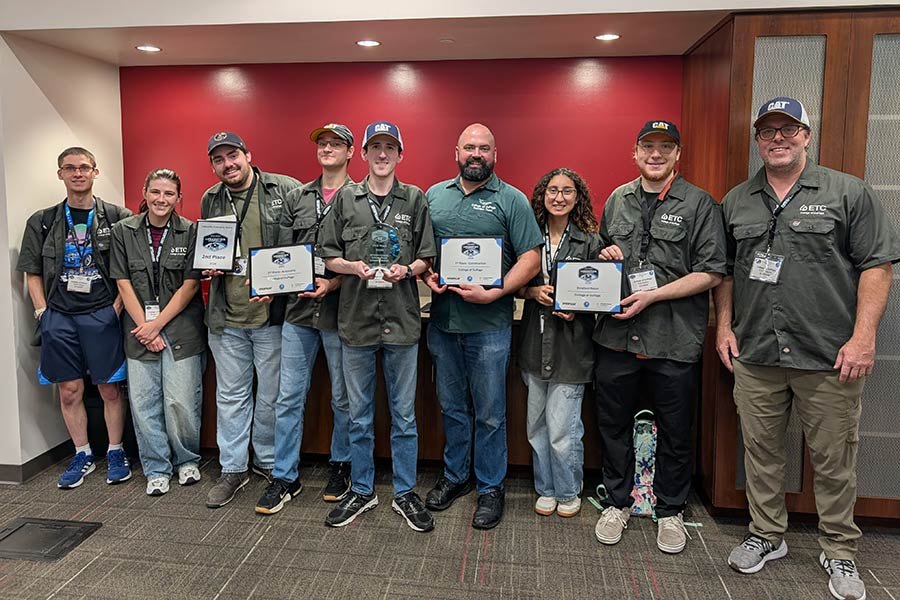
The College of DuPage Robotics team won first place at the 2026 NASA International Lunabotics Championship, beating teams from four countries after a last-minute computer failure nearly derailed their run.
COD was the only community college among the seven institutions that competed Monday, Oct. 26, through Thursday, Oct. 29, at the University of Central Florida in Orlando and the Exolith Lab in Oviedo, Florida, according to the college. The Glen Ellyn school was one of two U.S. colleges selected for the international field, which drew teams from the United States, United Kingdom, India and Australia.
The team finished day one in first place. Then the mini PC failed.
With two hours left before the final inspection on day two, team members purchased a replacement computer and configured it to operate the robot. They completed their final run and held onto the lead to win the championship.
"That moment perfectly captures why this team was so successful," said Eric Meloche, associate professor of physics at COD and the team's faculty advisor. "They weren't just talented engineers; they were problem solvers who trusted one another, adapted to unexpected challenges and refused to give up."
Each team was allotted two 25-minute runs in a simulated lunar environment. Judges evaluated the student-designed robots on berm construction, robot mass, energy efficiency, dust tolerance and autonomous operation. The robots excavated, transported and deposited simulated lunar soil.
Building on a spring win
The championship capped a strong season for the COD program. The team earned its invitation after finishing first in the Lunabotics Construction category at NASA's 2026 Lunabotics Challenge. That spring competition started with 47 teams in a qualifying round before the top 10 advanced to the final held May 19 through May 21 at NASA's Kennedy Space Center.
"This victory means so much for College of DuPage," Meloche said. "Through their hard work, dedication and determination, our students have helped put COD on the map, demonstrating what community college students are truly capable of achieving."
Before the October championship, Patch reported that team member Zachary Vollman described the robot as "basically a frame with a bucket that's centered on the frame." The bucket uses a vibration motor to collect simulated lunar soil, then lifts, drives to the depositing zone and dumps through the rear, Vollman said in that pre-competition coverage. Meloche told Patch the team competes against programs from large four-year universities with greater resources.
The University of Virginia won the overall Off World Grand Prize at the spring Lunabotics Challenge, where COD took the construction category title.